
Fat freezing can target suitable pockets of fat on the abdomen, flanks and thighs, while particular systems have been studied or labelled for selected smaller areas. But “can treat thighs” is only the start of the answer. The shape and position of your fat pocket must suit an applicator intended for that use.
An applicator is the part placed against the body to deliver controlled cooling. Its dimensions and contact with the tissue matter. A body-area list cannot establish personal suitability, and it does not tell you which treatments are available at our Belfast clinic.

Start with the tissue, then the area name
The target is subcutaneous fat: the layer beneath the skin. Reducing a local bulge is different from treating obesity or achieving meaningful weight loss. Cryolipolysis is not a treatment for visceral fat, which lies deeper around abdominal organs; it should not be presented as a route to the health benefits of weight loss. The FDA’s body-contouring guidance explains this cosmetic treatment’s limited purpose.
Skin also matters. If the concern is mainly loose skin, reducing fat may leave the original concern unresolved. The American Academy of Dermatology advises assessing loose skin when considering non-invasive fat removal. Describe what bothers you: a discrete bulge, hanging skin, surface dimpling or an overall change in size are different concerns.
Abdomen and flanks: neighbouring areas, separate plans
The abdomen is the front of the trunk; the flanks are the sides of the waist. A broad lower-abdominal pocket and a narrower bulge wrapping around the waist do not have identical outlines. Ask the practitioner to show which part of your concern the proposed applicator would cover, rather than accepting “stomach treatment” as a complete description.
Many systems use suction to draw suitable tissue into a cup. A large-looking area does not automatically fit a large applicator, nor does a small bulge necessarily fit a small one. The American Society of Plastic Surgeons discusses how fixed applicator sizes and body shape can affect fit and results. Pinching tissue yourself cannot establish a safe treatment plan.
Abdominal fullness also needs assessment for structural causes. Fat freezing does not repair muscle separation or a hernia. The FDA warns against treating in or near a pre-existing hernia or structurally weak area, including some scars and separated abdominal muscles. Mention previous surgery and any unexplained bulge before treatment. FDA safety guidance
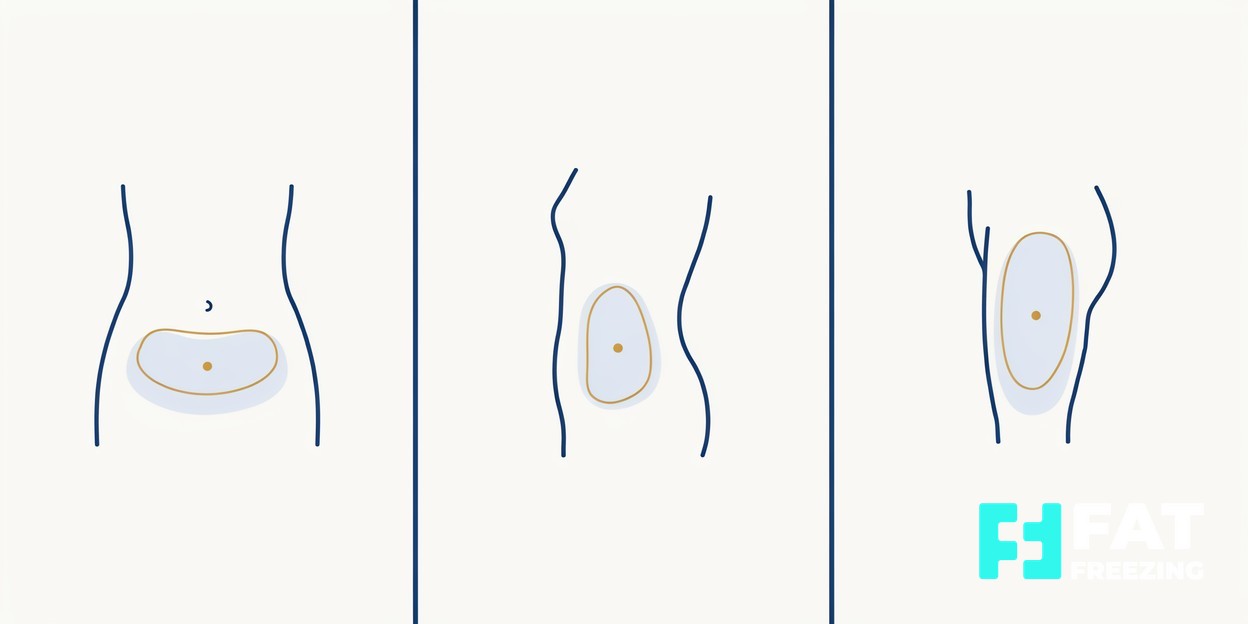
Inner and outer thighs show why applicators differ
“Thigh fat” is not one uniform target. The inner thigh and the outer thigh have different surface contours and may differ in how readily tissue can be drawn into a cup.
A study of arms and inner thighs used a flat-cup vacuum applicator in 20 women; 17 completed follow-up. It reported circumference reductions, but its small size and combined treatment areas limit what it can predict for an individual thigh. One participant could not complete treatment because of pain and numbness.
By contrast, an outer-thigh study investigated a conformable surface applicator because tissue there was difficult to draw into a vacuum cup. Forty participants had one thigh treated, with the other serving as a comparison. It was a non-randomised study of a particular prototype, not evidence that any cooling pad can treat outer thighs.
The useful lesson is about matching equipment to anatomy. These studies do not establish a universal thigh protocol or a guaranteed change in circumference. Ask separately about a local fat pocket and any cellulite or skin laxity; fat reduction should not be assumed to correct either.
Smaller regions need their own evidence
Under-chin fat occupies a much smaller space than an abdominal bulge. A 60-person submental study assessed a prototype small-volume vacuum applicator from the CoolSculpting system. It found local fat-layer reduction, but was open-label and non-randomised. That finding concerns the studied applicator and treatment plan, not every machine marketed for fat freezing.
The US manufacturer’s current indications for CoolSculpting and CoolSculpting Elite include specified under-chin and under-jaw areas, upper arms, back and bra-line fat, and the pocket beneath the buttocks, alongside abdomen, flanks and thighs. “Beneath the buttocks” is not the whole buttock, and “bra fat” is not breast tissue. The FDA states that no non-invasive body-contouring devices are cleared or approved for breasts.
These are US indications for named systems. They are neither UK authorisation nor a Belfast treatment menu. Ask our Belfast team which system they use and which smaller areas they assess before assuming a treatment is available.
Questions that turn an area list into a useful consultation
Use these prompts to clarify the proposed target and its limits. They are questions to ask, not a list of services offered locally.
| Region or concern | Question worth asking |
|---|---|
| Abdomen | Is the concern suitable surface fat, loose skin or something requiring medical assessment? |
| Flanks | Which part of the waist contour would this applicator cover? |
| Inner thigh | How does the proposed cup fit this pocket, and what change is realistic? |
| Outer thigh | Is this applicator intended for the tissue shape here? |
| Upper arm | How much of the concern is fat and how much is loose skin? |
| Under chin or jaw | Does this exact system have an appropriate applicator and instructions for this location? |
| Back or beneath buttocks | What precise pocket is proposed, and where are its boundaries? |
Ask for the machine’s name, the relevant patient information and the reason for choosing that applicator. Also ask what would make the practitioner advise against treatment. A plausible anatomical fit is only one part of suitability.
The manufacturer’s safety information excludes cryoglobulinaemia, cold agglutinin disease and paroxysmal cold haemoglobinuria for its systems. Disclose other cold reactions, circulation problems, pregnancy or breastfeeding, medicines, scars and surgery for assessment under the actual device’s instructions.
Temporary redness, bruising, discomfort and altered sensation can occur; burns are a less common complication. FDA risk information also describes paradoxical adipose hyperplasia: treated fat enlarges and hardens months later, does not normally resolve by itself and may need surgery. Obtain assessment for severe or worsening pain, blistering, marked colour change or a growing firm bulge.
Changes develop over weeks to months and vary; no area name promises a result or number of sessions. For an enquiry at 180 Lisburn Road, Belfast, bring a description of the specific change you want and ask the team which equipment and areas they assess.
Sources and further reading
- FDA: Non-invasive body-contouring technologies.
- American Academy of Dermatology: What to expect from non-invasive fat removal.
- American Society of Plastic Surgeons: Cryolipolysis and liposuction.
- Wanitphakdeedecha and colleagues: Arms and inner-thigh study.
- Stevens and Bachelor: Lateral-thigh conformable-surface applicator study.
- Kilmer and colleagues: Small-volume applicator study under the chin.
- CoolSculpting US: Device indications and safety information.
Frequently Asked Questions
Can fat freezing treat both the abdomen and flanks?
Certain systems are intended for both, but the front of the abdomen and the sides of the waist need separate assessment. The practitioner must check the fat pocket, skin, medical history and fit of the proposed applicator.
Are inner and outer thighs treated with the same applicator?
Not necessarily. Studies have investigated flat vacuum cups for inner thighs and a non-vacuum surface applicator for outer thighs. The evidence applies to those devices and protocols, so ask what is intended for your particular area.
Does a list of treatable areas mean Belfast offers all of them?
No. Published studies and manufacturer body-area lists do not establish this clinic's equipment or menu. Ask the Belfast team which machine and applicator they use and which areas they assess.
Can fat freezing reduce a deep, firm abdomen?
Cryolipolysis targets suitable fat beneath the skin, not visceral fat around internal organs. Firmness alone cannot identify the cause of fullness. Muscle separation, a hernia or an unexplained lump needs appropriate assessment rather than cosmetic self-treatment.

